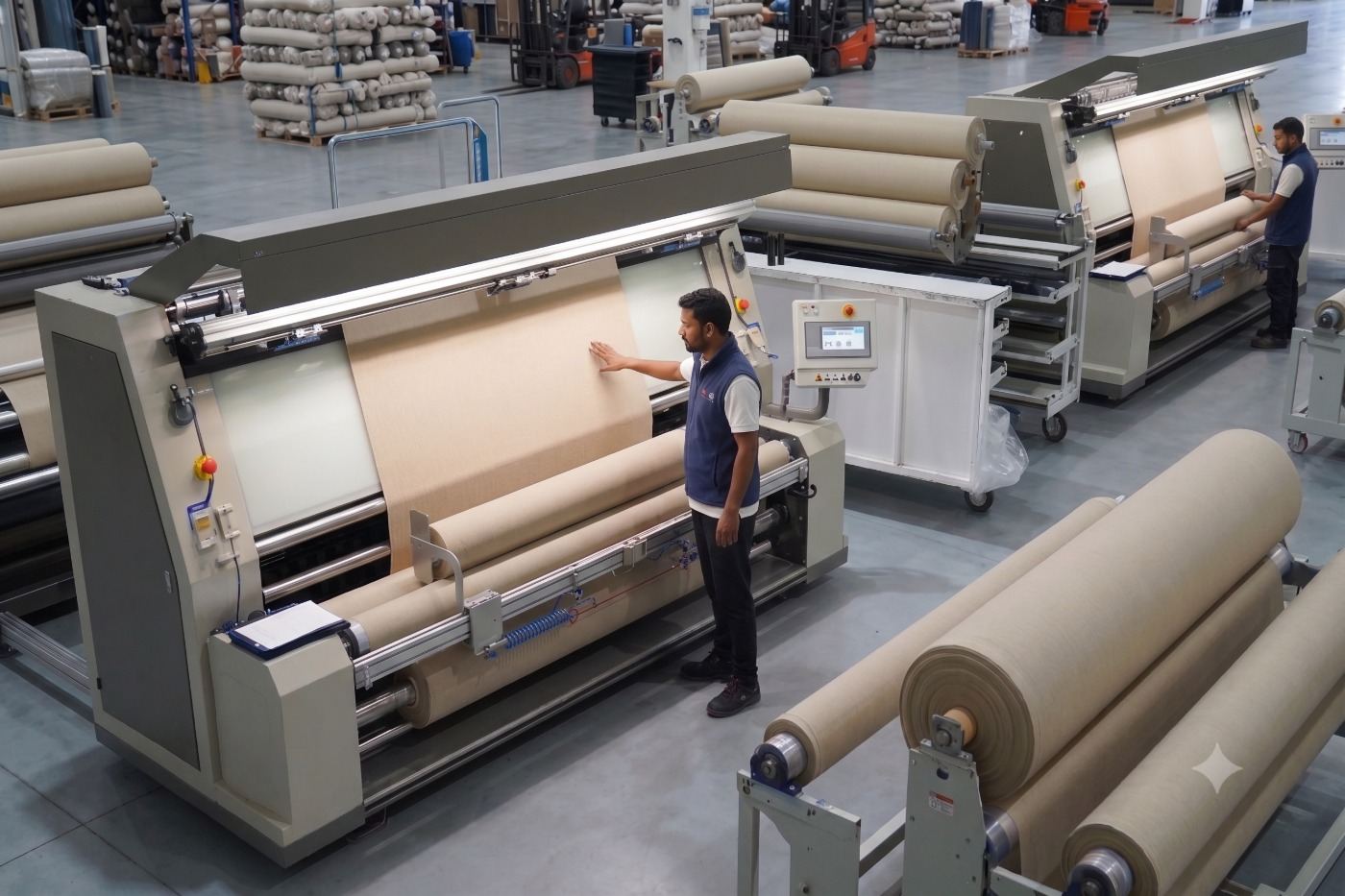
MOQ, or minimum order quantity, is the smallest quantity a mill will weave of one pattern. For a garment maker it decides whether a fabric fits a small capsule collection or only a full range. It is one of the first numbers to ask for, and one of the most misunderstood.
This guide explains why mills set an MOQ, how it applies to greige fabric, and how shirting and women's wear brands can plan around it.
Why mills set an MOQ
Setting up a loom for a new pattern takes time, labour and yarn. The warp has to be prepared on a beam, drawn in through the healds and reed, tied on and tested before the first saleable metre is woven. Each change of pattern also means some wasted yarn and a period when the loom is not producing.
On a long run, that setup cost is spread over many thousands of metres and becomes a small part of the price. On a short run, it becomes a large part. An MOQ keeps the price per metre stable and lets the mill plan loom time sensibly.
Per pattern, not per colour
Greige is undyed, so the MOQ applies to the pattern or construction, not to the shade. You can weave one greige lot and have it dyed in several colours at your processor.
For shirting and women's wear, this is often the simplest way to meet the MOQ and still offer a colour story. One NV dobby quality can become a white shirt, a sage co-ord set and a pink top, all from the same greige lot.
Typical numbers at GK Weaves
Our standard MOQ is 12,000 metres per pattern. Some constructions carry a lower MOQ: NV 56, for example, starts at 7,000 metres. A few qualities can be supplied by the thaan from stock. Each product card on this site lists its MOQ so you can see the number before you enquire.
Working out what the MOQ means in garments
Convert the MOQ into garments to see whether it fits your plan. Divide the MOQ by your average consumption per garment, including cutting wastage. Consumption depends on width, size ratio and style, so use your own marker figures.
For example, if a shirt style consumes about 1.6 metres of 58″ fabric, 12,000 metres gives roughly 7,500 shirts. Spread across several styles and colours, that is a normal quantity for a mid-sized brand's season.
How to plan a range around the MOQ
Share one base across styles. A shirt, a top, a dress and a co-ord set can all be cut from a single greige quality dyed in different shades. This keeps the fabric count low and each quality above its MOQ.
Combine men's and women's lines. If you make both, a nylon-viscose base can serve relaxed men's shirts and women's tops in the same season.
Split dyeing, not weaving. Weave the full greige quantity once, then send it to the processor in smaller lots as your sales data comes in. You meet the MOQ at the loom but keep flexibility on colour.
Book the repeat early. If a fabric sells, confirming the next lot in advance secures loom time before the season peaks, and your repeat will match the first lot more closely.
What affects the MOQ
MOQs are not arbitrary. They depend on the construction, the yarn and the loom type. Complex dobby designs may need more setup than a plain weave. Special yarns may have their own minimum purchase from the spinner. Stock qualities that the mill weaves continuously can often be supplied in smaller lots.
Questions to ask
Is the MOQ per pattern, per colour or per order? Is it greige metres or finished metres? Is there a stock option for this quality? How long will the MOQ quantity take to weave? Can the lot be dispatched in parts?
MOQ and price
Quantity and price are linked. Larger lots usually carry a better price per metre because setup costs are spread further and the mill can plan loom time efficiently. If you are close to a price break, it can make sense to combine two styles onto one quality to reach it. Ask the mill whether the price changes at higher quantities.
Stock fabric vs made-to-order
Stock fabric is woven ahead of demand and sold in smaller quantities, often by the thaan. It is useful for sampling, small capsules and quick replenishment. Made-to-order fabric is woven for your order to your specification, which gives you control over construction and consistency across repeats. Many brands use stock fabric to test a style and move to a made-to-order lot once it sells.
A worked example
Say a brand wants three summer shirt styles and two women's tops in one nylon-viscose dobby. With consumption of about 1.6 metres per shirt and 1.3 metres per top, 2,000 shirts and 2,500 tops need about 6,450 metres before wastage. That already meets a 7,000 metre MOQ with a small allowance, and dyeing the greige in four shades gives twenty options on the shop floor from one weaving order.
Below the MOQ? Ask anyway
If your quantity is under the MOQ, tell us. Depending on the loom schedule, existing stock and whether the construction is already running, there may be an option. Send the fabric name and quantity on WhatsApp and we will tell you what is possible.