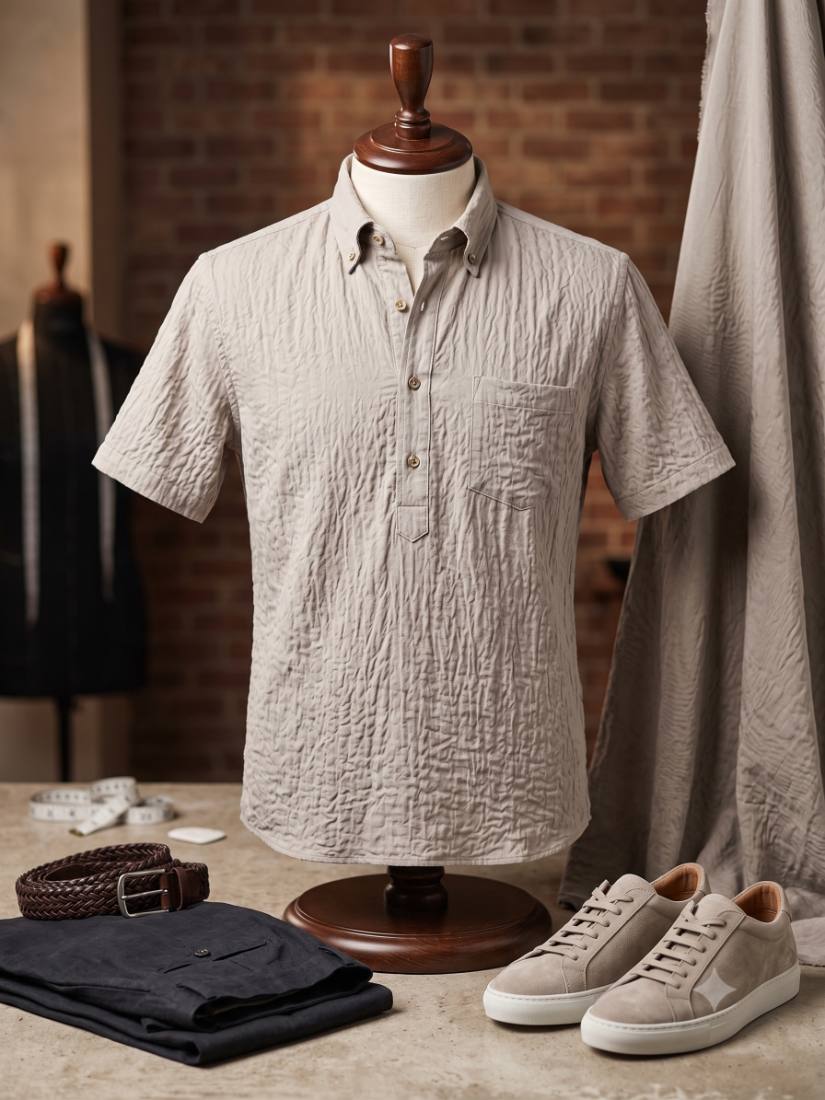
Two numbers appear on almost every greige quote from Surat: GSM and panna. Reading them correctly lets you compare suppliers fairly, cost a garment accurately and avoid surprises when the fabric comes back from the processor.
This guide explains both numbers, how they change in processing, and how to use them when you plan shirting and women's wear.
What GSM means
GSM stands for grams per square metre. It is the weight of one square metre of fabric, and it is the most common way to describe how heavy or light a fabric is.
Most shirting and women's top fabric sits roughly between 90 and 140 GSM. Lighter fabric, towards the lower end, drapes and feels cool, and suits summer shirts, tops and flowing dresses. Heavier fabric is more opaque, holds structure and suits overshirts, structured shirts and bottoms. Suiting and furnishing fabric are heavier again.
How GSM is measured
GSM is measured by cutting a standard circular sample, usually 100 square centimetres, with a GSM cutter and weighing it on a precise scale. The weight in grams is multiplied by 100 to give grams per square metre. Take samples from several points across the width and along the roll, because weight can vary slightly.
GSM changes in processing
Greige GSM and finished GSM are not the same. During dyeing and finishing, fabric usually shrinks in length and width, which makes it denser and heavier per square metre. Some finishes add weight; others, such as washing treatments, can remove size and reduce it.
Viscose-rich blends tend to change more than polyester-rich ones. Always agree whether the figure on the quote is greige GSM or finished GSM, and ask your processor what finished GSM to expect from a given greige.
What panna means
Panna is the fabric width, quoted in inches. It is the usable width from one edge to the other, usually measured without the selvedge. Common greige widths include 44″ and 58″, with other widths available depending on the loom and construction.
Like GSM, width changes in processing. Fabric usually narrows as it shrinks. Ask whether the quoted width is greige width or finished width, and agree the expected finished width with your processor before you order.
Why width matters for costing
Your cutting marker is planned on usable width. A wider panna often fits more pattern pieces across, which reduces metres per garment. A shirt that needs 1.6 metres on 58″ fabric may need noticeably more on 44″ fabric.
For this reason, compare prices per metre only between fabrics of the same width. When widths differ, convert both to price per square metre, or better, to fabric cost per garment using your own marker.
A quick conversion
Weight per running metre in grams equals GSM multiplied by width in metres. To convert inches to metres, multiply by 0.0254.
A 120 GSM fabric at 58″ (1.47 m) weighs about 177 grams per running metre. The same GSM at 44″ (1.12 m) weighs about 134 grams per running metre. This matters when fabric is priced or shipped by weight, and when you estimate how many metres are in a roll of known weight.
Other numbers on a spec
Beyond GSM and panna, a full greige spec may include composition, weave, reed and pick (warp and weft density), yarn counts or deniers, and roll length. You do not need to master all of them, but asking the mill to state them makes it easier to reorder exactly the same fabric.
Checklist for your enquiry
When you enquire, state: composition, weave, GSM (and whether greige or finished), panna (and whether greige or finished), quantity and target shade. If you have a reference fabric, send a photo or a swatch.
GSM and garment feel
GSM alone does not tell you how a fabric feels. Two fabrics at the same GSM can feel very different depending on fibre, weave and finish. A 110 GSM nylon-viscose dobby will drape and breathe differently from a 110 GSM polyester plain weave. Use GSM to compare fabrics of the same blend and construction, and rely on a physical sample to judge hand feel.
Tolerances
No fabric is woven to an exact GSM or width on every metre. Agree a tolerance with your supplier, for example a few percent either side of the stated GSM and a small margin on width. Put the tolerance on the purchase order, so both sides know when a roll is within specification and when it is not.
Using the numbers in your costing
Once you know finished width and GSM, you can work out fabric cost per garment accurately. Multiply metres per garment from your marker by finished price per metre, then add your expected cutting wastage. Doing this for each quality you are considering is the quickest way to see which fabric really suits your target price.
Selvedge and usable width
The selvedge is the firm edge woven along both sides of the fabric to stop it fraying. It is usually not used for cutting. When you plan a marker, work from the usable width inside the selvedges, not the full width. If a quote does not say whether width includes the selvedge, ask, because a difference of even half an inch on each side can change how many pieces fit across the fabric.
On our product cards
Every GK Weaves product card on this site lists composition, weave, GSM and width, so you can compare qualities before you enquire. For anything marked "On request", send us your requirement on WhatsApp and we will confirm the numbers for your order.