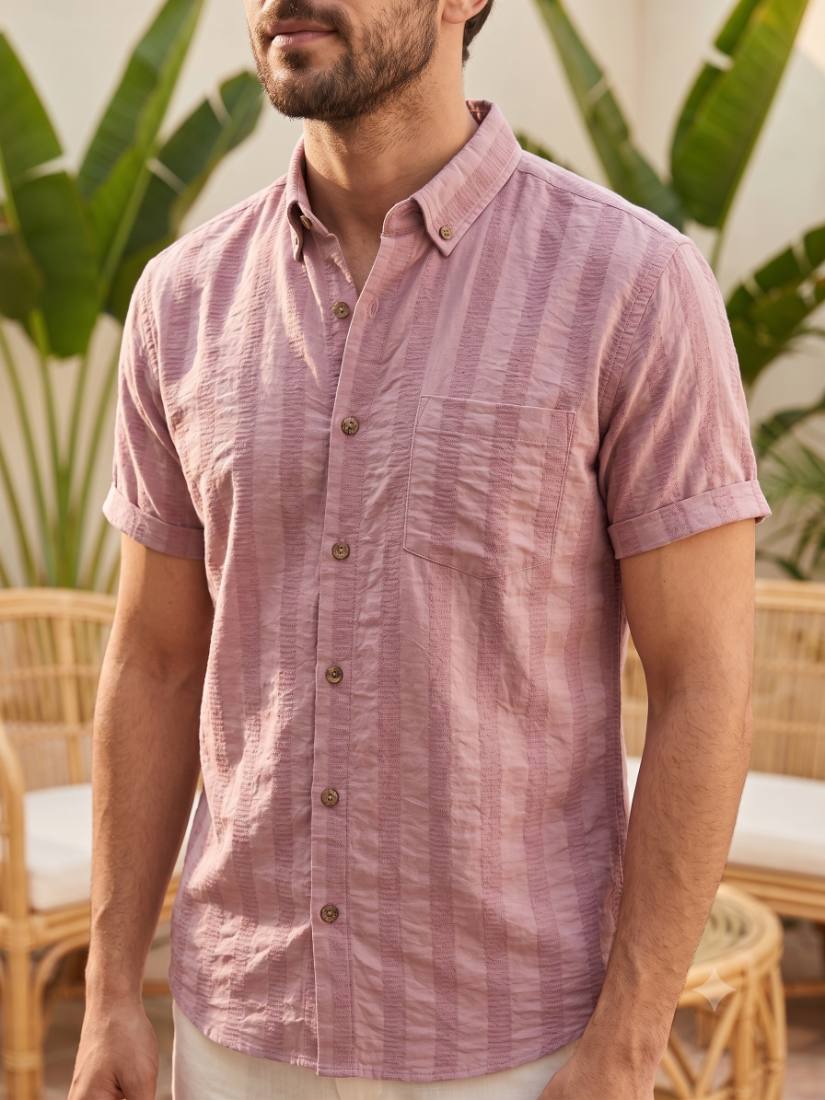
If you make shirts or women's tops, the two greige blends you will be offered most often in Surat are nylon-viscose (N x V, usually shortened to NV) and nylon-polyester (N x P). Both typically carry about 15% nylon. The other 85% decides how the finished garment looks, feels, processes and sells. Choosing the wrong one is rarely a disaster, but it shows up in returns, in the dyeing bill and in how quickly a style sells through.
This guide compares the two blends from a garment maker's point of view: hand feel, drape, dyeing, shrinkage, costing and the kind of garments each suits best.
What nylon-viscose fabric gives you
Viscose is a regenerated cellulose fibre made from wood pulp. It is not a true synthetic, and it behaves more like cotton or rayon than like polyester. NV fabric drapes softly, breathes well and feels cool against the skin. It absorbs moisture, so it is comfortable in Indian summers and in humid export markets.
Viscose also takes dye with depth. Colours look rich rather than flat, which suits the dusty pinks, sage greens, washed blues and off-whites that are common in premium shirting and resort wear. The nylon component adds tensile strength and abrasion resistance, and it helps textured weaves such as dobby, seersucker-style stripes and crinkle finishes hold their surface through processing.
NV shirt fabric is the usual choice for relaxed shirts, camp-collar and resort shirts, co-ord sets, kurtas and women's tops where hand feel matters. The soft, slightly crinkled surface you see on Zara-style summer shirts is a typical nylon-viscose look. Brands in the premium high-street segment use this kind of fabric because the customer notices the feel in the trial room.
What nylon-polyester fabric gives you
Polyester is a fully synthetic filament fibre. In an N x P blend it brings crease resistance, dimensional stability and a lower price per metre. N x P holds its shape, dries quickly, resists pilling and needs less care from the end customer. It rarely shrinks noticeably after the garment is made.
That makes N x P a good fit for structured shirts, uniforms and workwear, linings, padding fabric and any garment where durability matters more than drape. It is also a sensible base for price-sensitive ranges where the costing has little room.
The trade-off is breathability and hand feel. N x P feels crisper and warmer on the skin, and it does not absorb sweat the way viscose does. It also dyes differently: the polyester takes disperse dyes at high temperature and the nylon takes acid dyes, so a two-bath or carefully matched process is needed to get an even shade.
Side by side
Hand feel: NV is soft and fluid; N x P is crisp and smooth. Drape: NV falls close to the body; N x P holds a structured line. Comfort in heat: NV breathes and absorbs moisture; N x P can feel warm. Crease resistance: N x P is better; NV creases more and relies on the weave texture to hide it. Shrinkage: NV needs an agreed allowance; N x P is stable. Price per metre: N x P is usually lower.
How to choose for your garment
Start with the garment, not the fabric. Three questions settle most decisions. Will it be worn next to the skin in heat? Does the design depend on drape or on structure? What price is the finished garment selling at?
If the answers are heat, drape and a mid-to-premium price, NV is usually right. This covers most women's tops, summer shirts, co-ords and fashion kurtas. If the answers are durability, structure and tight costing, N x P usually wins. This covers uniforms, formal shirts that must stay pressed, and linings.
Some brands use both: NV for the front-of-store fashion styles and N x P for basics and repeat programmes. Because both blends are woven in greige and dyed later, you can often keep the same construction and texture across both and change only the fibre.
Tell your processor the blend
Your dyeing house needs to know the exact composition before the lot goes in. Viscose shrinks more than polyester in wet processing, typically in both length and width, so NV women's apparel fabric needs a shrinkage allowance agreed before dyeing. Ask your processor what finished width and GSM they expect from the greige you are sending.
Always ask for a short length dyed in your actual shade before you book the full quantity. A strike-off costs a few days. Re-dyeing a full lot costs far more.
Costing notes
Compare the two blends on the finished fabric cost, not the greige price alone. NV greige may cost more per metre, and the processing loss from shrinkage adds to it. N x P may need a more expensive dyeing process. Add greige price, processing charge and expected loss, then divide by the finished metres you will actually cut. That is the number to compare.
Care labels and customer expectations
The blend also changes what goes on the care label. NV garments generally do best with a gentle wash, cool water and line drying, and many brands recommend ironing on the reverse. N x P garments tolerate machine washing and tumble drying better. If your customers expect easy-care basics, set expectations on the label and in the product description so a soft NV shirt is not returned for creasing that is part of its character.
A short note on sustainability questions: buyers increasingly ask about fibre origin. Viscose is plant-derived, while polyester and nylon are petroleum-based. If your brand communicates fibre content to customers, keep the composition on your spec sheet accurate so product copy matches the fabric.
Getting samples
GK Weaves weaves both blends on its own looms in Surat, including NV 56 dobby and the N x V and N x P Hammer textures. Send us the garment you are developing, the target shade and the quantity you are planning. We will suggest a construction and send greige samples so your processor can run a trial before you commit.