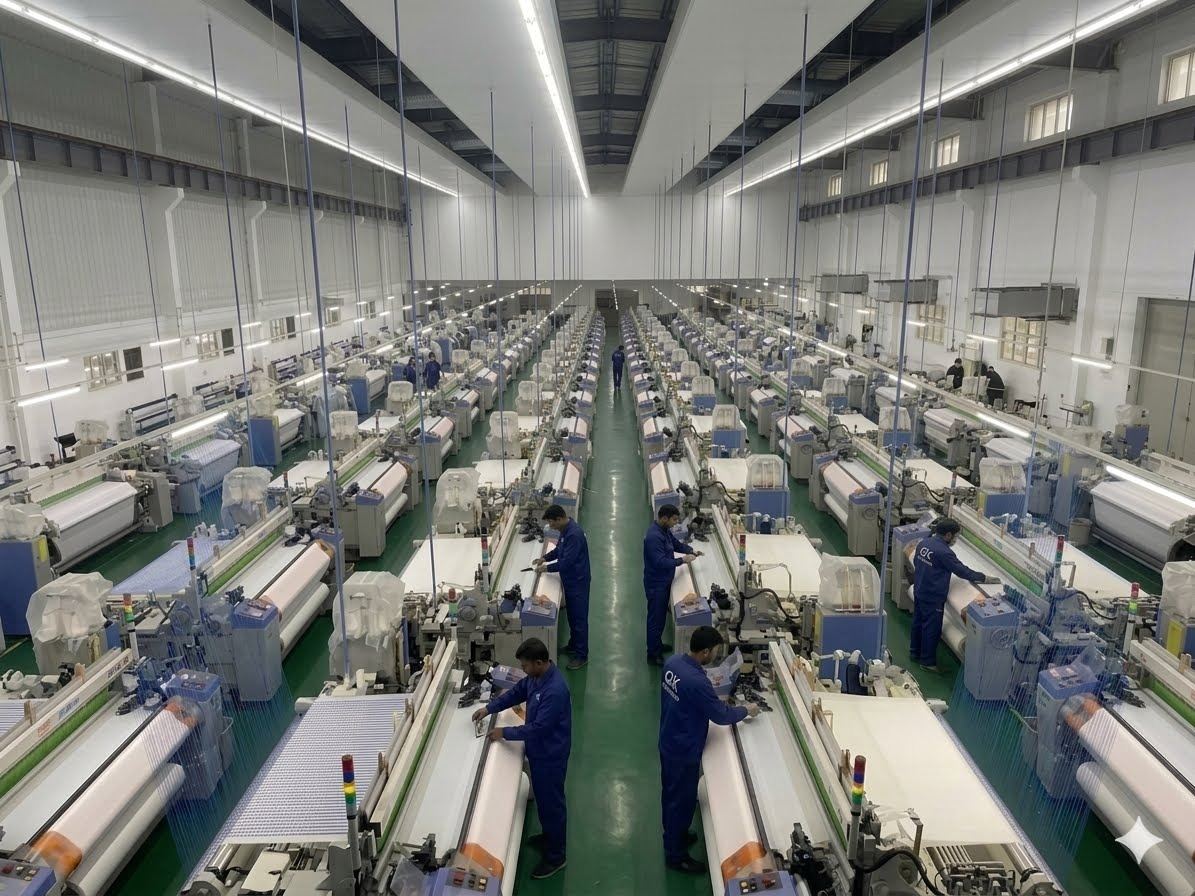
Most greige fabric in Surat is woven on shuttleless looms, and two types dominate the city's loom floors: water-jet and air-jet. As a garment maker you rarely choose the loom yourself, but the loom type affects which yarns can be used, how quickly a lot is woven, what the fabric costs and how consistent it is across a large order.
Understanding the difference helps you ask the right questions when you source shirting and women's wear fabric.
A short background
Older shuttle looms carried the weft yarn across the warp inside a wooden shuttle. They were slow and noisy, and much of that capacity has been replaced. Shuttleless looms insert the weft by other means: rapier, projectile, water jet or air jet. In Surat's synthetic weaving sector, water-jet and air-jet looms account for a large share of modern capacity.
How water-jet looms work
A water-jet loom carries the weft yarn across the warp on a fine, high-pressure jet of water. The water drags the yarn through the shed, the reed beats it into place, and the fabric passes over suction to remove excess moisture.
Water-jet looms are fast and energy-efficient, and they are relatively simple to maintain. They suit filament yarns that do not absorb water, such as polyester and nylon. Much of Surat's polyester and nylon-polyester shirting, dress material, lining and suiting comes off water-jet looms.
The limit is the fibre. Water-jet looms are not suited to absorbent yarns such as viscose or spun cotton, which take up water and weave poorly. They also work best with filament yarns rather than spun yarns.
How air-jet looms work
An air-jet loom inserts the weft with compressed air. A main nozzle fires the yarn into the shed and a series of relay nozzles along the reed keep it moving to the other side. Air-jet looms run at high speed and produce very consistent fabric.
Because they use air rather than water, air-jet looms handle spun and absorbent yarns, including viscose and its blends. That makes them the usual choice for nylon-viscose shirt fabric and women's wear fabric, as well as other constructions that need a soft, even surface.
Air-jet looms cost more to run because compressed air uses a lot of electricity, and they need a well-maintained compressor and air supply. In return they give fine control over weft insertion and suit a wide range of yarns.
Side by side
Yarns: water-jet suits polyester and nylon filament; air-jet also handles viscose, spun and blended yarns. Speed: both are high-speed, with air-jet often faster on suitable constructions. Running cost: water-jet is generally lower; air-jet uses more power. Typical Surat output: water-jet for polyester and N x P qualities; air-jet for NV and viscose-rich shirting and dress fabric.
What it means for buyers
Choose the blend first; the loom follows. If your garment needs the drape and breathability of nylon-viscose, it will be woven on air-jet looms. If polyester or nylon-polyester suits the garment, water-jet looms can weave it efficiently.
Then ask the mill which loom type your quality runs on and whether they have enough of those looms to meet your delivery date. A mill with plenty of water-jet capacity but only a few air-jet looms may struggle with a large NV order in peak season.
Consistency across a large order depends on running it on matched looms with the same settings. When a lot is spread across looms at different workshops, small differences in tension, pick density and maintenance show up as variation from roll to roll. That variation often becomes visible only after dyeing.
Questions to ask your supplier
How many water-jet and air-jet looms do you run? Are they your own? Which loom type will my quality be woven on? How many looms will run my lot, and will they all be on the same floor? How do you check consistency between looms before dispatch?
Does the loom affect hand feel?
The loom itself does not decide whether a fabric feels soft or crisp; the yarn, construction and finishing do. What the loom affects is which yarns are practical and how evenly they are woven. An even, consistent weave takes dye more uniformly and cuts more predictably, which matters for shirting where a visible fault on a front panel means a rejected garment.
Loom type and delivery time
Both loom types are fast, but delivery depends on how many looms a mill can dedicate to your quality at once. A 12,000 metre lot spread across several looms is ready far sooner than the same lot on two. When you place an order, ask how many looms will run it and what the weaving time will be, then add processing time at your dyeing house to get a realistic ready date.
Water use and the environment
Buyers sometimes ask whether water-jet weaving uses a lot of water. Modern water-jet looms use filtered water, and many units recirculate and treat it. Air-jet looms use no water in weaving but draw more electricity for their compressors. If your brand reports on environmental impact, ask the mill how it handles water and power on its loom floor, and keep the answer on file with your supplier records.
Our loom floor
GK Weaves runs 180 water-jet and 120 air-jet looms, all owned, on our factory floor in Surat. That lets us weave polyester and nylon-polyester qualities alongside nylon-viscose shirting and dress fabric without sending work outside. Lots are inspected on our own fabric inspection machines before dispatch. Send us your fabric reference and we will tell you which looms it will run on and when it can be ready.